Garage door won't close: the checks, in the order that finds it fastest
A door that won't close is usually telling you something true about what's under it or how it's running. Most of the causes take two minutes to find and a few of them you can fix yourself. The rest need a technician, and here's how to tell which is which.
Start with the lights
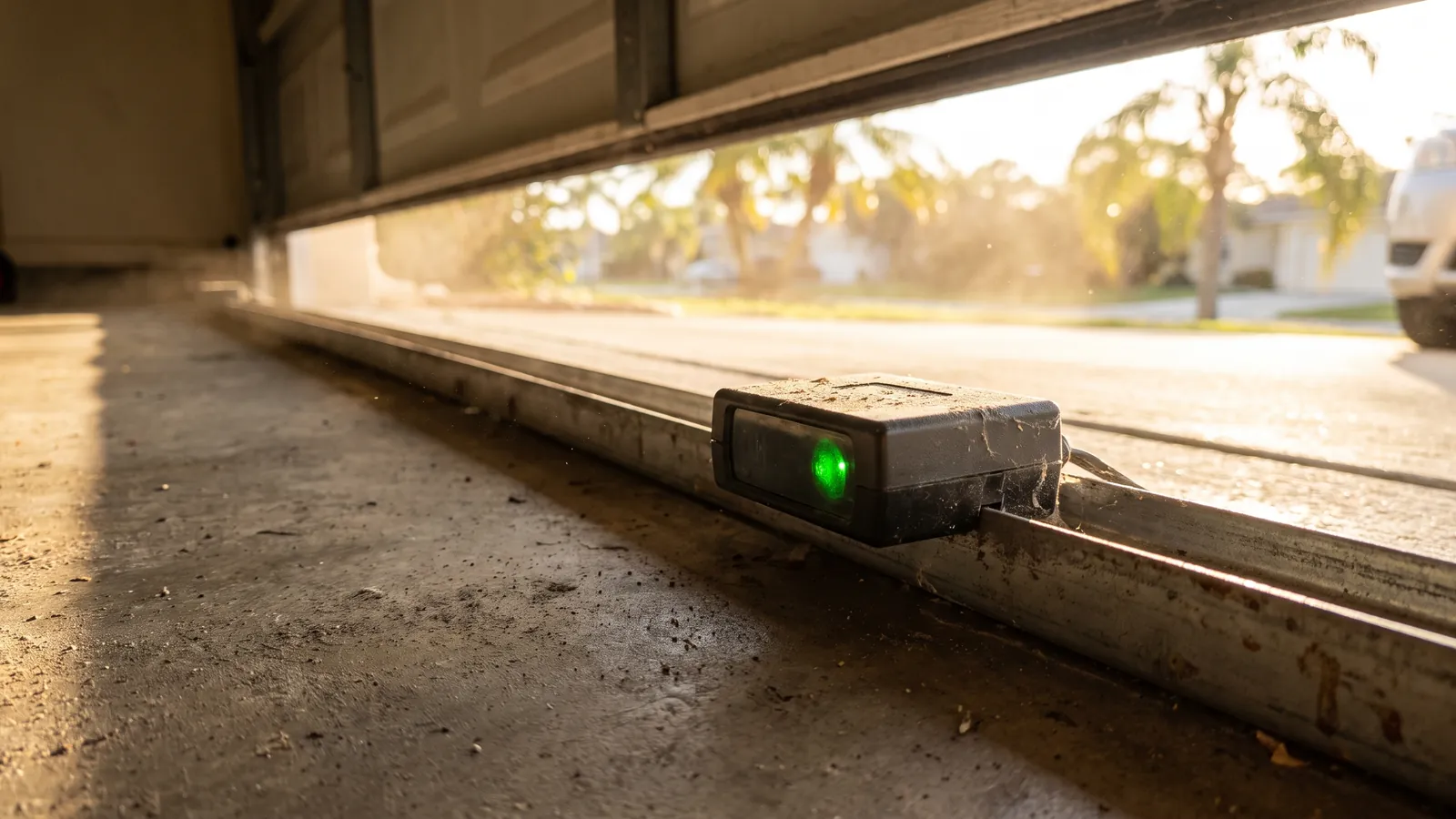
When the door won't close from the remote or the wall button and the opener's light blinks (on many LiftMaster and Chamberlain units, ten times), the opener is telling you it can't see the safety beam. Go to the two small sensors near the bottom of the tracks, about six inches off the floor. Each has an indicator light. Both steady means aligned; a flickering or dark receiver means blocked, misaligned or unpowered. Look for a trash can, a bike wheel, a cobweb or a leaf across the lens, wipe both lenses, and loosen the wing nut to re-aim the eyes at each other until both lights hold steady. If the door closes from the wall button when you hold it down, that confirms it: the override bypasses the sensors, and the problem is the sensor system.
Then the sun
A west-facing garage that fails only in the late afternoon is a sun problem: low light floods the receiving eye and the opener reads a broken beam. Shade the receiver with your hand and press the button; if it closes, swap the sender and receiver sides or add a shield. We do this a dozen times a month on SR 200.
Then the wire
If a light is dark and the lens is clean, follow the thin wire from the sensor up to the opener. Florida garages are hard on it: lawn tools cut it, shelves pinch it, and rodents and lizards chew it. A splice or a rerun fixes it. If both lights are dark, the opener's sensor circuit may have died in a surge, which means the logic board.
Then the limits and the force
If the sensors are fine and the door closes all the way, then goes back up, the down travel limit is set a little too far and the door is hitting the floor and interpreting it as an obstruction; a quarter turn of the limit adjustment fixes it. If the door reverses partway down with the beam intact, something is making the door harder to move than the close-force setting allows: a dry or worn roller, a bent track, a hinge that's binding, or springs that have lost tension so the opener is fighting the door's weight. Don't just crank the force up; that defeats the entrapment protection. Find the friction.
Then the door itself
Disconnect the opener (the red cord, with the door closed) and move the door by hand. A balanced door lifts with one hand and stays where you leave it. A door that's heavy, drifts down, or sticks at one spot in the track has a spring, cable, roller or track problem that no opener setting will fix, and that's where to stop and call. A door that's crooked or has a cable hanging loose should not be moved at all.
When to call
Call when a sensor light stays dark after cleaning and realigning, when the wire is damaged, when the door is heavy or crooked by hand, when a spring is visibly broken, or when the opener is dead after a storm. All of those are same-day calls, and sensors are one of the cheaper repairs on the price list.
Common questions
Why does holding the wall button close it?
Holding the wall button is the opener's override for the safety sensors. It's meant to let you close the door when the sensors are obstructed, and it confirms the sensors are the problem.
Can I just disconnect the sensors?
No. Most openers won't run without them, and bypassing them removes the reversing protection that keeps the door off a child or a pet.
The door closes but then opens again right away.
Down limit set too far, so the door hits the floor and reverses, or the close force set too low. Both are adjustments on the opener. If it only does it in the afternoon, it's the sun on a sensor.
The opener is completely dead.
Check the outlet with a lamp, then the breaker. If the outlet is live and the opener is dark, the board is likely gone, usually from a surge. Pull the red cord with the door closed and operate the door by hand until it's fixed.
Something chewed the sensor wire. Is that normal here?
Common enough that we carry wire. We reroute and staple it clear of the floor and the track.
How much is a sensor fix?
Realignment and cleaning is the service call, $79 to $129; a new pair installed and aligned $110 to $220; wiring $90 to $180.
Related: Sensor repair · Opener repair · Repair cost guide · Tune-ups